Circumpolar Race Around the World (CRAW)
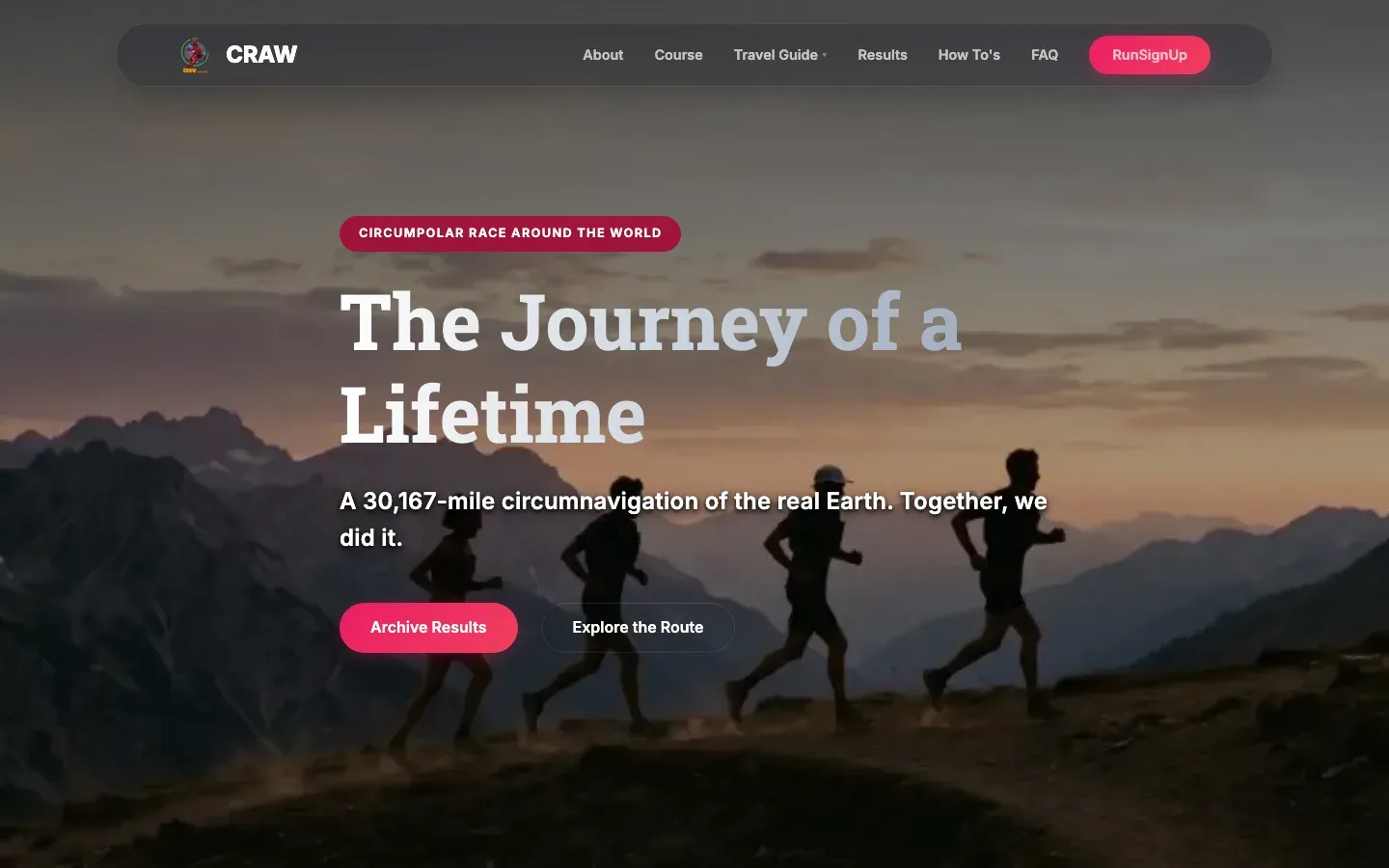
Every race in the world had been cancelled. So we built one that went around it.
How do you send 7,329 people around the world during a pandemic, without any of them leaving home?
It started with GVRAT. In the summer of 2020, more than 19,000 people ran across Tennessee without leaving home. It was a success, but it only ran for four months, from May to August. It was the middle of COVID, people were stuck at home, and the runners wanted something more.
So while GVRAT was still going on, Gary Cantrell, better known as Laz, came up with a new idea: the Circumpolar Race Around the World, or CRAW. We talked through how to make it happen, and I shaped the concept into a working system and got it started straight away.
It was a welcome race. Runners who had done GVRAT could now take on a bigger challenge together: running around the world as a team of up to 10, with teammates from anywhere, either as a running team or as a multisport team of cyclists, skiers, paddlers and more.
The published route was 30,167 miles (48,550 km) through 12 regions, starting and finishing at the US–Mexico border: south through Latin America, the Andes and the Pampas, across Antarctica, then through Australia, the islands of Southeast Asia, India, Central Asia, Europe and the far north before heading home. It launched in September 2020.
My part
Gary created the idea and directed the race. For four years, I carried sole responsibility for everything else: the design, engineering, implementation and day-to-day technical operation. As the only developer, I made the technical decisions, built and maintained the system, fixed whatever broke, and kept it growing as the race went from 12 regions to 18. I was also the systems engineer, managing the server the site ran on, and the graphic designer, from the runners’ passports to the medals and buckles they earned.
The challenge
A race this long had to make sense at two very different scales: one person’s run today, and a team’s progress over months or years. Participants needed to see how their miles counted, where their team stood and what came next. Registration, mileage, regions, results, the stories of the places along the way and the medals at the end all had to feel like one journey, one that people could come back to week after week without ever thinking about the technology behind it.
Turning miles into a race
Registration and activity records lived on RunSignup. I built a system that read all of that data through the RunSignup API, brought it together, and calculated the results team by team, with Google Apps Script doing much of the heavy lifting.
The logic is what made it interesting. Teams entered one region at a time. A region’s clock started the moment the first person on the team logged miles in it, and kept running until the team’s combined miles carried it across that region’s finish line. Then the team signed up for the next region, and a new clock began. Teammates could also change between regions.
So the results were never one simple leaderboard. Hundreds of teams were each on their own clock, in their own region, starting at different times, and every team’s progress had to be right.
A passport for every runner
A journey around the world needed a passport. I designed a virtual CRAW passport for the runners, issued by “CRAW World HQ” at Hercules Dome, Antarctica, and dated 1 September 2020, the day registration opened. It carries each runner’s details and a machine-readable line along the bottom, just like a real one.
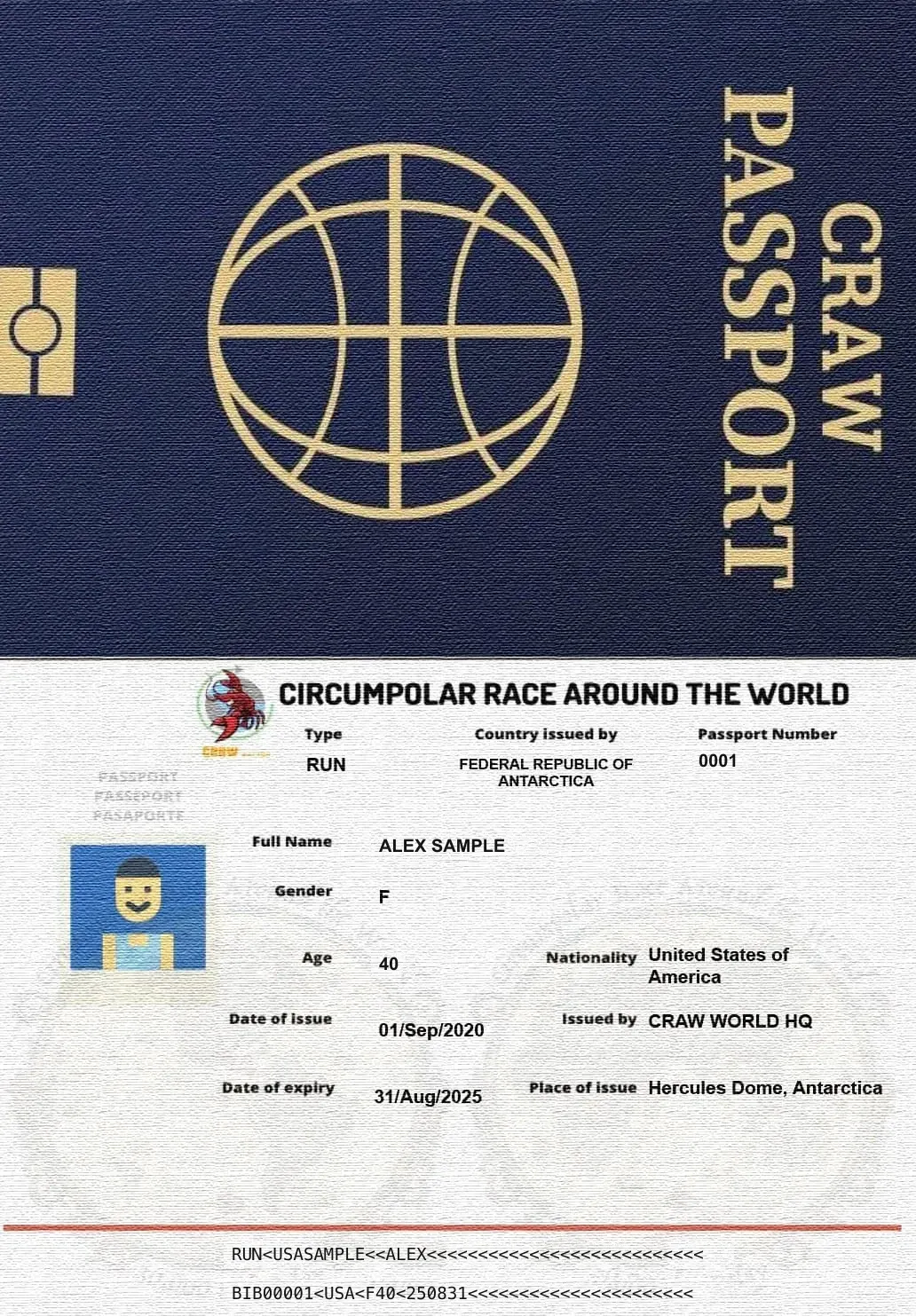
A sample passport, with placeholder details in place of a real runner's.
Medals that become a map
The idea I’m proudest of is the one runners could hold. Every region a team finished earned a metal medal in the shape of that part of the world, with the route the team had travelled traced across it. On their own, they’re medals. Put together, the pieces form a world map on a wooden display board, with the team’s whole journey running across it, one region at a time.
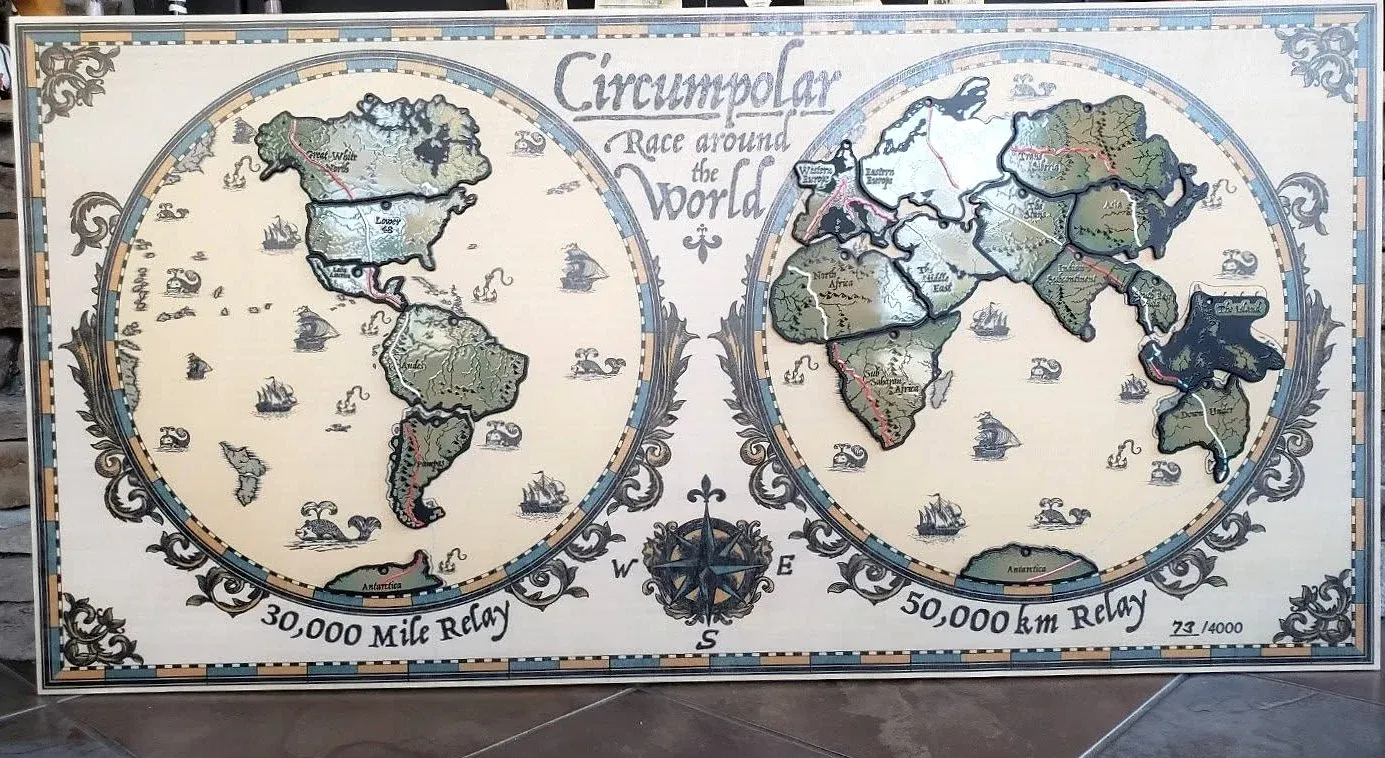
The display board, with the region medals in place, including the bonus regions in Africa, Europe, the Middle East and Asia. Photo shared by a CRAW runner.
Teams that went all the way round earned a buckle: both hemispheres, the full route in red, and “30,000 Mile Relay” on one side and “50,000 km Relay” on the other.
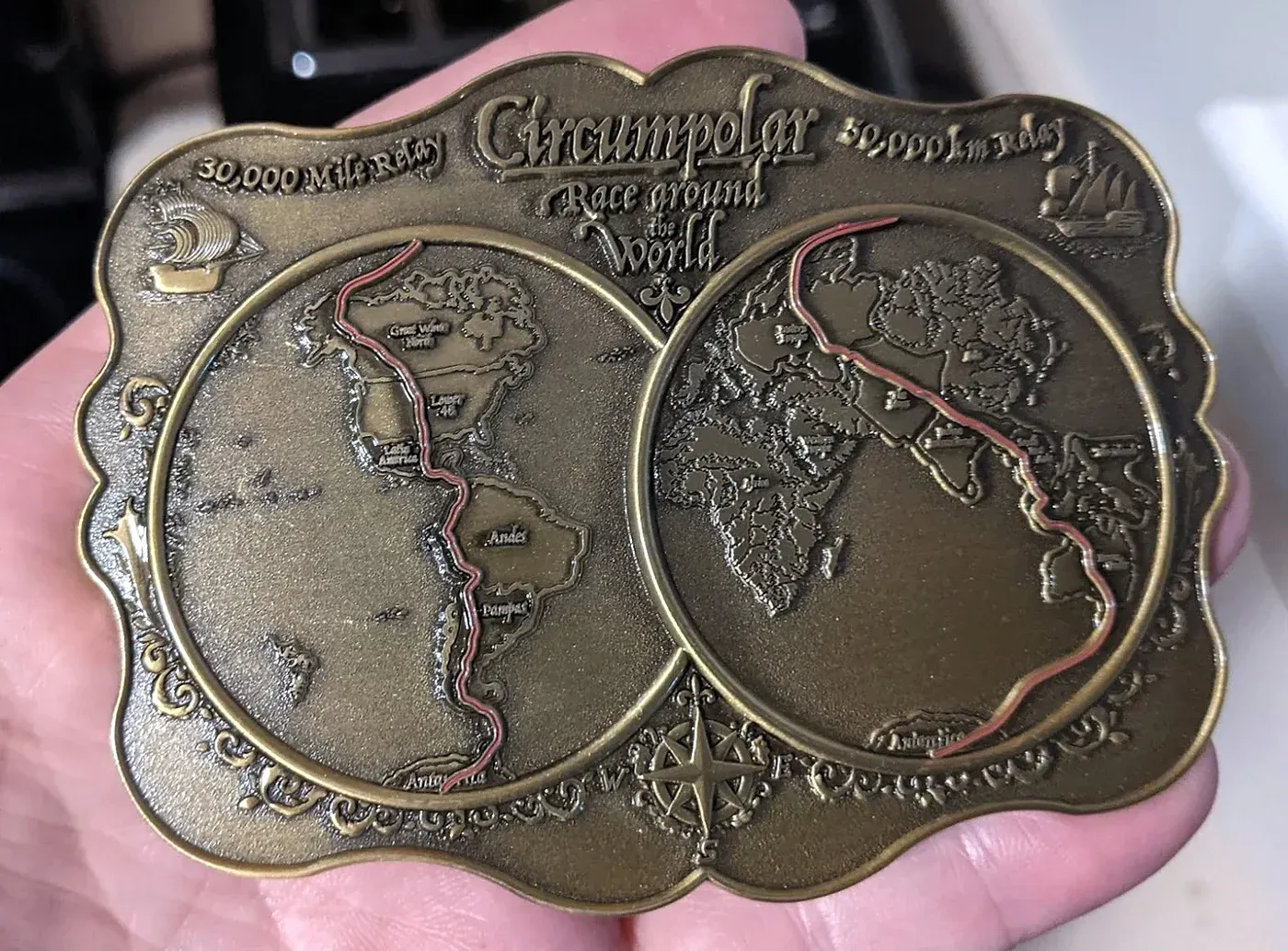
The finisher's buckle. Photo shared by a CRAW runner.
A course that kept growing
Twelve regions turned an enormous goal into stages a team could manage, and each region came with its own medal. Many teams didn’t want it to end, so six bonus regions were added: Sub-Saharan Africa, North Africa, Western Europe, the Middle East, Trans-Siberia and Asia. The technology had to grow with the race, and keep working for every team until the finish was finally closed at the end of 2024.
Stack
- Registration and activity: RunSignup, read through the RunSignup API.
- Data processing and results: Google Apps Script, used extensively.
- Website: WordPress.
- Infrastructure: a self-managed VPS, which I administered as the project’s systems engineer.
By the numbers
- 54,949 registrations from 7,329 participants: on average, each one signed up about seven or eight times, coming back region after region.
- 48 countries and territories, from Andorra to the United Arab Emirates.
- 30,167 miles through 12 regions, plus six bonus regions.
- Four years, from September 2020 to the end of 2024.
All 48 countries and territories
Andorra, Argentina, Australia, Austria, Belgium, Bermuda, Brazil, Bulgaria, Canada, China, Curaçao, Denmark, Finland, France, Germany, Ghana, Greenland, Guernsey, Hong Kong, Iceland, India, Ireland, Israel, Japan, Jersey, Lithuania, Malaysia, Mauritius, Mexico, Netherlands, New Zealand, Norway, Philippines, Poland, Portugal, Puerto Rico, Romania, Russia, Saint Kitts and Nevis, Singapore, South Africa, South Korea, Spain, Sweden, Switzerland, United Arab Emirates, United Kingdom and United States.
The outcome
Every one of those registrations, in every time zone, had to land in the right team, the right region and the right result. By November 2022, Marathon Handbook counted 208 running teams and 427 multisport teams that had completed at least one region.
For many of them it was more than a race. One club, Northbrook AC, had teammates spread across England, Wales, the Netherlands, Germany and Canada, and called it a positive memory from a difficult time. That was the point: an ordinary day’s exercise, close to home, as part of something extraordinary with other people.
CRAW is among the most significant things I’ve done: an ambitious idea taken through design, delivery and four years of operation, with the technology and its continuity resting on me the whole way.